Introduction
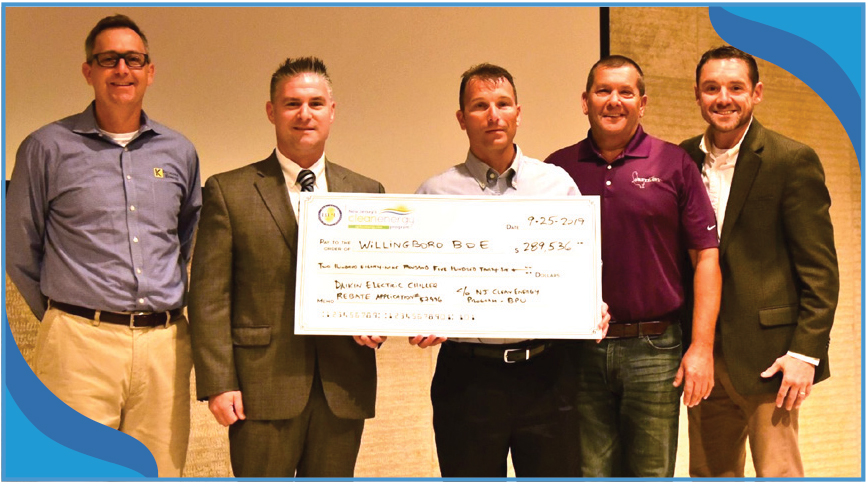
In today’s challenging energy landscape, maximizing financial incentives is critical for any commercial HVAC project. Since 2019, Ed Ciechon (Senior Sales Engineer at TriState HVAC) and Chad Moore (Square K Energy) have helped secure over $1 million in rebates and incentives for engineers, owners, contractors, and architects. The two organizations collaborate to focus on the continually changing landscape of local utility rebates and the powerful federal 179D tax deduction. These programs are key to lowering equipment costs, reducing infrastructure investment, and improving overall project payback.
The Energy Efficiency Opportunity: Ventilation Reduction
Before seeking to obtain rebates or incentives, building and facilities managers should seek to reduce the energy consumption of their structures. Energy efficiency starts with load reduction. A significant opportunity lies in reducing
the amount of outside air that needs conditioning. Approximately 40% of the U.S.’s energy consumption is allocated to buildings. Of that building energy, 40% of the HVAC energy consumption is dedicated to conditioning ventilation air.
By utilizing the ASHRAE IQP calculation, engineers can demonstrate a reduction of up to 75% of the ventilation air required.
Reducing ventilation air lowers equipment size and cost, reduces building infrastructure costs (through smaller penetrations), reduces utility bills, decreases the building’s carbon footprint, and improves project payback. Technologies such as ionization or desiccant systems can be utilized to meet indoor air quality needs while reducing ventilation requirements.
Once loads are determined, an energy analysis can compare different systems (e.g., water-cooled chillers versus air-cooled chillers) to determine the most optimal path for a 25-year investment.
Utility Rebates (The “Rebate” Side)
Utility incentives, commonly referred to as rebates, are available for both renovation and new construction projects.
The following breakdown offers insights into the rebate opportunities available to New Jersey-based facilities:
New Jersey Utilities (Renovations)
- Incentive Type: Rebates are available for both gas and electric equipment.
- High Value: Strong returns are typically seen on VFDs (on chiller, hot water, and condenser water pumps) and condensing boilers.
- Custom Rebates: These involve engineering models and pay a fixed rate per kWh saved against an ASHRAE 90.1 baseline.
- Retroactive Window: New Jersey utilities typically offer a 120-day look-back window for completed projects.
New Jersey Clean Energy (New Construction)
- Scope: This state-level program handles new construction projects, including ground-up builds and extensive gut rehabs.
- Deadline Alert: Look for the new program details online at: https://www. njcleanenergy.com/residential/ncp
New Jersey COOL Program (Grants)
- High Value: This pilot program offers grants for projects involving fuel switching (gas to electric) or refrigerant replacement. The minimum award can be $50,000, covering a greater percentage of the project cost than traditional rebates.
Federal Incentives: The 179d Tax Deduction
The 179D tax deduction allows commercial building owners to accelerate depreciation for energy-efficient improvements.
There are key changes from the Inflation Reduction Act (IRA). The deduction now amounts to approximately $5.65 per square foot for projects utilizing prevailing wage labor, or $1 per square foot if prevailing wage labor is not employed. The IRA now allows private non-profit entities (like private schools) to allocate the deduction to their design team (architects, engineers, contractors).
When 179D Makes Sense (Size Guidelines) Due to the costs associated with the required third-party certification and energy modeling, the tax deduction is most valuable for larger projects:
- With prevailing wage labor, projects as small as 25,000 to 30,000 square feet can be good candidates for the full allocation.
- Without Prevailing Wage Labor: Projects generally need to be at least 75,000 to 80,000 square feet to justify the expense and time.
Qualification Process & Critical Deadline The deduction requires formal certification by a licensed third-party engineer and energy modeling to demonstrate at least a 25% reduction in energy compared to the ASHRAE 90.1-2007 baseline.
Projects must be started by
July 1, 2026 to qualify for the deduction.
Don’t Leave Money on the Table
The key to maximizing these incentives is to plan early. TriState HVAC recommends discussing rebate and tax deduction opportunities at the very start of your project.
Do not be overwhelmed by the complexity. Ed Ciechon and his team can quickly provide a “back of the napkin” estimate to determine if pursuing these incentives is worthwhile for your specific project.
Explore what your project could qualify to receive. Reach out to Ed Ciechon at TriState HVAC at eciechon@tristatehvac.com.