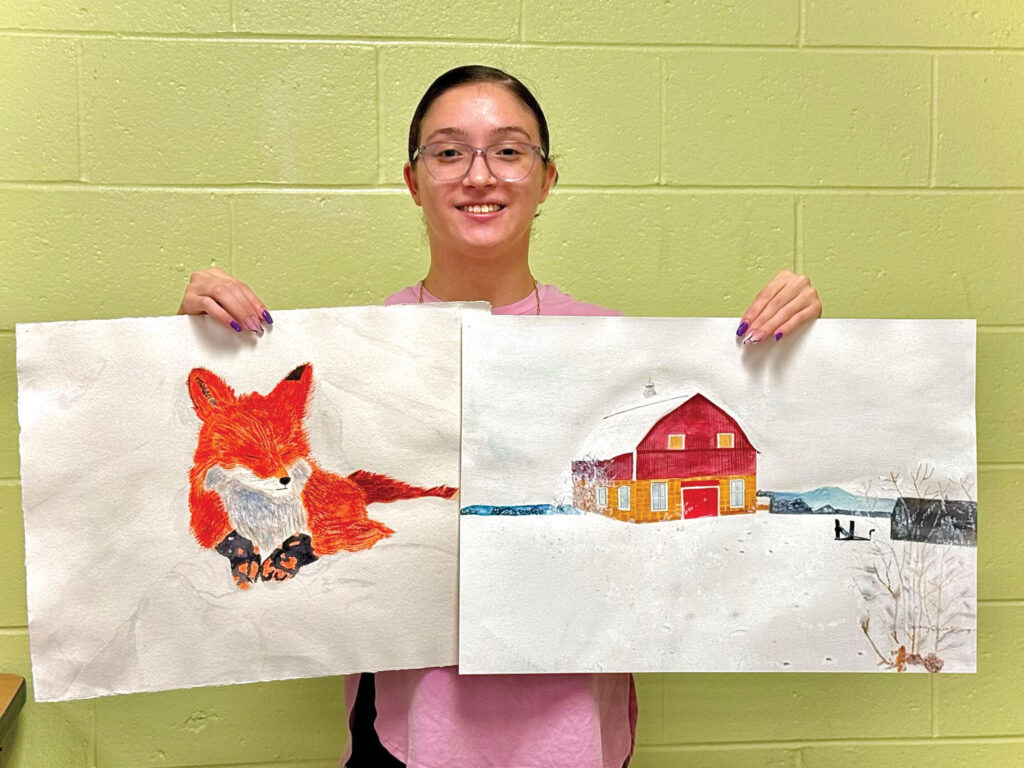
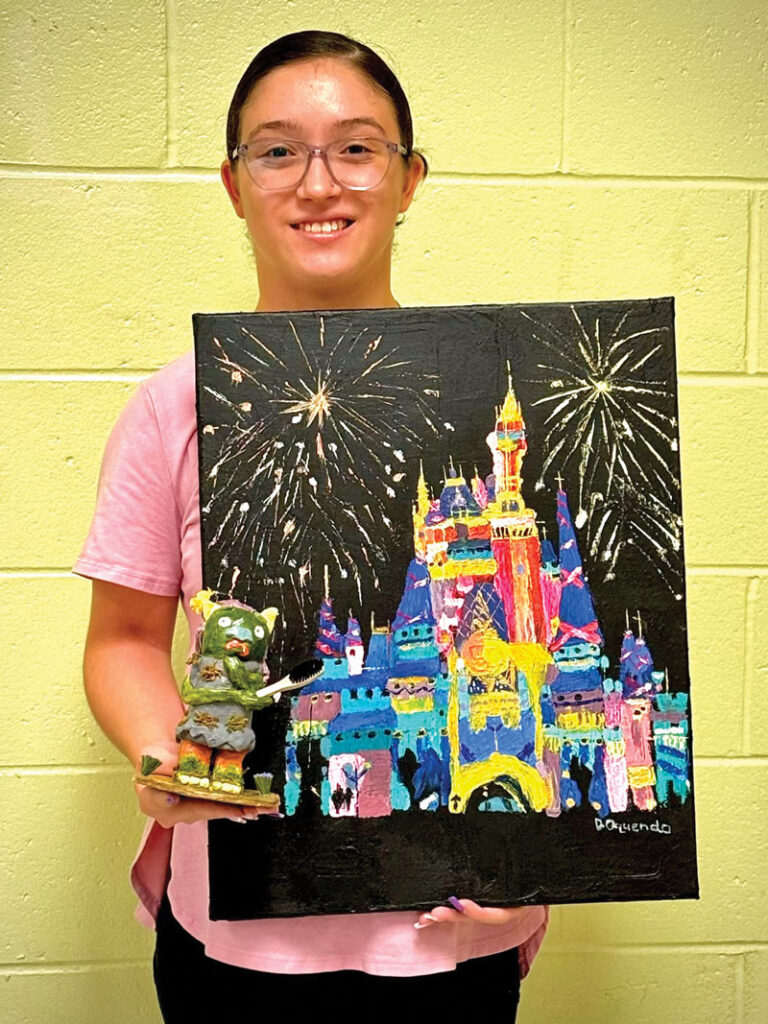
For recent Haddon Heights Sr. High School graduate Destiny Oquendo, a love of painting and drawing has helped her form meaningful connections with her community and beyond, despite serious health issues. Now, she is headed to Rutgers University-Camden this fall to pursue a degree in art education with a minor in art therapy and plans to work with students with special needs in the future.
After living with her own challenges from mild cerebral palsy, that as a sophomore left her needing a wheelchair for a few months while recovering from a surgery, Oquendo, now 18, said she found that art helped her relax and become more focused at school.
“Art gave me more room to grow as a person,” the Barrington Township resident said. “I tried to use it to be more expressive than using words, instead of speaking. I show that in my work with using colors or shapes or textures.”
As Oquendo prepares to take the next step into college for arts education, the arts in public schools across the country have been increasingly vulnerable as art-focused organizations, nonprofits and public school districts have been faced with billions in proposed federal cuts. However, relief came in late July when $5.5 billion in frozen federal funds were released for public education for the arts and music in low-income districts, support for children of migrant workers, students learning English as a second language, for recruiting teachers and helping students with special needs, among other programs that were in the crosshairs, according to a New York Times report.
Proposed Federal Funding Cuts Still, there are federal budget proposals for Fiscal Year 2026 to merge or cut several programs affecting the arts that could have lasting effects, according to the National Music Council of the United States.
The National Association for Music Education detailed the potential negative impacts on arts education, if those plans are approved. In addition, National Endowment for the Arts (NEA) grants have already occurred, and there are proposals to nix the federal agency all together.
Countless communities will likely debate and some will consider scaling back or eliminating their arts programs as a result, said Wendy Liscow, Arts Ed NJ executive director, who has worked in the arts industry for decades.
“Whenever there’s any threats to budgets in schools, we know superintendents and principals have to make very difficult decisions and they look to places where they think it will have minimal impact — where it is not going to impact testing, and they often cut the arts,” Liscow said. “We are starting to see the attrition and it is not looking good for next year, and a lot of people fight to get them back.”
Continuing teacher shortages for the arts also is a concern, not unlike other subject areas, her group’s research has found. Between May 25 and June 2 this year, Arts Ed NJ surveyed 120 visual and performing arts supervisors in the state and found more than 77% reported experiencing reductions to arts education in their districts during the 2024-2025 school year, while others faced a decrease in arts courses, materials and budgets for supplies.
Liscow said her own organization lost a $100,000 national endowment for the arts grant just in the last two years. That money funded all of the group’s advocacy work such as a school board candidate surveys about their attitudes and interests in public arts education. The group then used that research and publicized it with the goal of informing voters.
Arts Ed NJ is a non-profit “collective impact model” organization comprised of statewide corporate, charitable and education partners that work to ensure all pre-kindergarten through grade 12 students participate in a high quality, equitable arts education. Arts Ed NJ’s mission is to celebrate “diverse lived experiences and artistic expression” preparing students for leadership roles in the future. Its steering committee is made up of major arts associations, visual and music and other forms, such as the NJPAC and Pushcart Players; plus superintendents, parents, teachers, higher education partners and the New Jersey School Boards Association.
“I’ll tell you, most people fought for the art teacher, because that is why kids come to school. There are some kids that hate art as much as I hated gym,” she said jokingly. “There are so many different art forms, right? And it’s where you can be yourself. It’s where you can find a little bit of joy and express yourself and maybe color outside the lines. How you are graded is different, and not always by being the same, but by being different.”
Drop-out Rates and Absenteeism Reduced Liscow pointed to studies that have shown chronic absenteeism and high school dropout rates fell, and overall academic improved with dedicated arts programming in public schools. Students who have the lowest rate of dropout are those who take more than the mandated one credit in arts education, according to an Arts Ed Search paper, which evaluated the high school dropout rate nationally taking arts into consideration.
Liscow said she believes districts would be making a big mistake by cutting the arts, especially in middle schools because that is a major developmental time for children who typically are grappling with a sense of belonging, finding their voice and developing a sense of agency. Also, middle school arts are the pipeline for successful arts programs in high schools, including marching bands, visual arts, theater and choir.
“Middle school kids need arts more than anything, really. Think about the mental health issues…the transitions that happen in middle school,” she said. “They’re lost. They’re finding themselves.”
Research conducted in 2022 in 42 elementary and middle schools in Houston, found that infusing the arts into education can boost overall school engagement including student academic outcomes in vocabulary, writing, cognitive and emotional empathy. In addition, researchers Daniel H. Bowen and Brian Kisida, found decreased disciplinary violations and an increase in higher education goals, according to a New York Times article exploring their findings.
Partnering with the New Jersey Department of Education, Arts Ed NJ recently presented the “Governor’s Awards” at NJPAC in Newark, where students from throughout the Garden State performed. Some students gave speeches, including one 9-year-old who said their life was saved because of their exposure to the arts.
At another statewide music education event, Liscow talked about a choral winner who said he was going to become a teacher because of his love for it.
“That is the best way we’re going to get rid of the shortage. Because when you have great teachers, you want to become a teacher,” Liscow said. “Not only do you go on to be a doctor, or a designer, you bring that gift to others…That moment where you go, ‘I’m going to do that. I am going to be that!’ That happens in the arts, and it gets you.”
In Haddon Heights Jr. Sr. High School in Camden County, longtime arts educator, Joseph Smargisso, said he has found that in his 28 years of teaching in public schools and at universities, that art serves as a critical creative outlet and can also lead to important career pathways.
“Arts education is an important part of human development. People need to express themselves to find their voice and it can help them as creative problem solvers,” said Smargisso, whose background is in industrial design. “Every student is an artist and should take art until their senior year.”
It was through his student, Oquendo, that a connection was made with Arts Ed NJ one summer. She then formed a student arts council and created an official Instagram school page (3hs_artscouncil) specifically dedicated to promoting the arts at her high school including musicals, industrial art, photography and other types of art classes. Smargisso, the high school student art council’s advisor, recalled when Oquendo impressively presented her plan to the district’s board of education and an Arts Ed NJ Youth Leadership Council. He said that Oquendo used the arts to fuel her confidence and desire to create and help others as it has benefited her over the years.
She also spoke to students at the Haddon Heights School District’s Annual Neurodivergence Conference last May, where she discussed her upbringing, her challenges and how art helped her express herself. Oquendo said she really got into art during her junior year, when she worked with paint brushes, fingerpainting and a palette knife in art class.
“I kind of had control of the art palette and how I make shapes and different sizes,” she said. “Art can go all different ways. Some kids with special needs do not know how to express themselves with words, so they can use paint to express themselves.”
Neurodivergence is the non-medical term used to describe people whose brains and thinking may operate differently. People who identify themselves as neurodivergent may be on the autism spectrum, have dyslexia, social anxiety or sensory processing disorder, among other conditions. According to the Cleveland Clinic, their possible strengths can include a better memory, being able to mentally picture three-dimensional (3D) objects easily, the ability to solve complex mathematical calculations in their head, and many more positives.
“She’s really determined. She’s not going to let anything hold her back,” Smargisso said about Oquendo.
Public School Arts Education is Mandated In New Jersey, there is administrative code that requires visual and performing arts to be one of the nine content areas taught in public schools. High school graduation requirements include five credits, or the equivalent of one year, in visual and performing arts, effective this past school year. The New Jersey Core Student Learning Standards, NJSLS, also mandates that kindergarten through fifth grade students be given “broad-based exposure” in the arts.
For Arts Ed NJ’s Liscow, she said she believes having the arts in public schools is essential because not all parents can expose their kids to it.
“How do you get a kid to experience that unless it’s in school?” she said.
For Oquendo, she views art education in school as a priority and sees all the subjects fitting together like a puzzle. For example, in science, students have to draw. There are paintings in history class that teach and reflect the times such as the Civil War, allowing students to picture and imagine what it was like during that tumultuous period.
“Art and other subjects should be combined and work with one another. Instead of pushing one subject aside, it would be all of them,” she said.
In keeping with that idea of putting the arts center stage, Arts Ed NJ collects artwork from throughout the state and lines the hallway to the main stage at NJSBA’s Annual Workshop in Atlantic City, where thousands of school board members and district officials gather for professional development and fellowship and industry providers attend and can view the works of New Jersey’s talented students.
“My biggest dream is that school board members get to witness the achievements of their art students and are as excited about art students’ achievement as they are about sports or any other academic successes,” Liscow said.
Rosa Cirianni is the owner of Rose Write Strategies and is an NJSBA consultant.