SPONSORED CONTENT
Two ninth-graders sit in adjacent classrooms, both reading To Kill a Mockingbird. In one room, students explore justice and moral courage through Socratic seminars and multimedia projects. Next door, students analyze Harper Lee’s craft, focusing on Scout’s narration and how the author’s choices shape meaning.
Both approaches are valuable. But without curriculum mapping, districts can’t ensure these lessons line up in a coherent sequence that builds over time. What starts as variation around one shared text can quickly lead to gaps, redundancies, and missed opportunities districtwide.
New Jersey educators rank among the best in the country and work tirelessly to provide excellent instruction. Still, without systems to connect their efforts, even the most talented teachers can’t guarantee consistency across classrooms and grade levels.
Curriculum mapping takes the long view—clarifying what knowledge should endure, how subjects connect, and how skills progress from grade to grade—while ensuring rigorous coverage of standards.
The benefits extend beyond students; curriculum mapping also supports teachers. New Jersey’s educator pipeline has been shrinking for over a decade. The number of individuals completing teacher training dropped 50% between 2009 and 2018, a steeper decline than the national average. This makes retaining and supporting existing teachers all the more urgent, especially since half leave the profession within ten years and replacements often start from scratch. It’s incredibly difficult for new teachers to generate high-quality curriculum while also learning the ins and outs of a new profession in a new district. A built-in curriculum available from day one ensures a more sustainable practice and greater continuity for learners.
It’s no wonder New Jersey has moved to strengthen curriculum through the state’s new Literacy Framework, which emphasizes high-quality instructional materials as a foundation for student success—a positive step toward better outcomes statewide.
District leaders know what they want for students: a rigorous, coherent, standards-aligned curriculum. The challenge is translating that vision into daily classroom practice.
Talk to teachers on the ground, and the same three key challenges surface:
1. Mapping is complex work.
Not everyone is a curriculum writer, and not every district team is equipped to build its curriculum well. It’s a tremendous task to ensure all standards—across all subjects and all grades—are covered.
Picture a curriculum team staring at a list of 200 math standards. Which grade tackles fractions? When do students encounter algebraic thinking? There are overlaps—third-graders work with basic multiplication while fourth-graders dive deeper into multi-digit problems. The team has to make sense of this progression and organize it into manageable chunks—maybe eight units per year, with five standards clustered in this unit, seven in that one.
Then comes the detailed work of breaking each unit into daily lessons and assessments. How will teachers know if students master those fraction concepts? What’s the most effective way to teach multi-step word problems? Every single standard needs this level of attention. Doing it all—while ensuring vertical and horizontal alignment, standards coverage, and engaging pedagogy—requires an iterative process and constant collaboration.
2. Curriculum gets lost.
Even with a well-developed curriculum, distribution becomes exponentially harder for larger districts with multiple buildings and ongoing teacher turnover.
Too often, curriculum sits in shared drives across different folders. Version control becomes a disaster. We’ve all seen drives with no organizational system, with document versions like “final_final_exam.” These carefully crafted materials end up filed away, never making it to classrooms.
In my previous school alone, we had 7,000 documents in our shared drive. At the district level, that number increases dramatically. Any mapping efforts lose their impact if teachers can’t access what they need, when they need it.
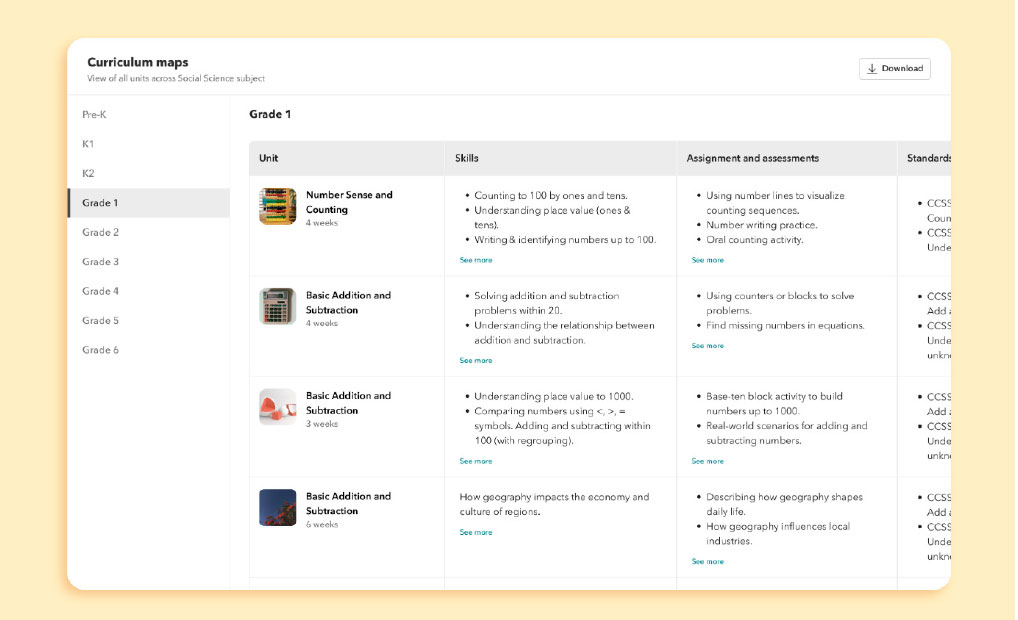
3. Planned and taught curriculum diverge.
Even with some version control in place, districts often struggle to know whether the planned curriculum is the one that’s actually taught. If materials sit neatly filed away while teachers improvise, the benefits of mapping are lost.
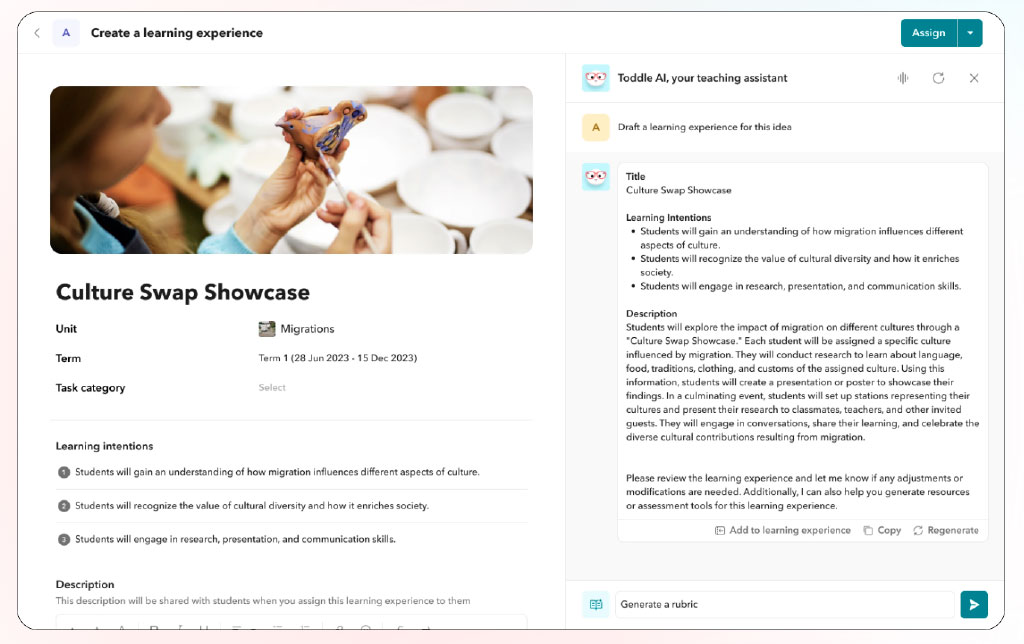
To realize the promise of curriculum design, districts must ensure that planned curriculum and taught curriculum go hand in hand. When you’re writing curriculum in Google Docs, mapping it in spreadsheets, and asking teachers to somehow connect it all to their daily practice, it’s very difficult to achieve that alignment.
The solution requires more than goodwill and isolated efforts. It calls for systems and tools that make curriculum design manageable, accessible, and sustainable across entire districts.
That’s where purpose-built technology has an important role to play. Platforms like Toddle are designed specifically for this kind of work.
With AI embedded in the workflow, curriculum creation becomes more efficient and collaborative. Teachers can draw on an AI-powered Curriculum Design Assistant to generate course outlines, suggest learning experiences, and create differentiated tasks in minutes—giving them back valuable time while raising the overall quality of instruction. In a recent survey, 95% of teachers using Toddle reported saving two to five hours every week—precious time they can reinvest in their students.
Curriculum maps and analytics then provide a clear, comprehensive view of a district’s program, making it easy for teams to stay aligned and for leaders to make informed decisions. Reports are fully standards-aligned and flexible in format, ensuring transparency at every step. Version control and role-based sharing keep access smooth, even with staff turnover.
From there, implementation flows naturally. Teachers can assign directly from mapped materials, while administrators maintain visibility into classroom practice. Feedback loops capture teacher insights at the district level, supporting continuous improvement.
This connected workflow is why over 2,000 schools and districts across 100+ countries now use Toddle. When creation, access, and implementation come together in one intuitive platform, teachers reclaim time, students receive more personalized support, and districts see stronger outcomes.

I’d love to share more about how Toddle can support your district’s vision. My team and I are excited to join the NJSBA’s Workshop in October as first-time sponsors, and I hope to see you there. Until then, you can learn more about what Toddle offers at toddleapp.com.
1. Walsh, S., et al. (2023, August). New Jersey’s current teacher workforce landscape. Heldrich Center for Workforce Development. www.nj.gov/education/rpi/docs/2023_New_Jersey_Current_Teacher_Workforce_Landscape_Report.pdf
2. Elevate K-12. (2024, June 21). How to solve the teacher shortage in New Jersey. Elevate K-12 Blog. www.elevatek12.com/blog/elevate-in-action/teacher-shortage-nj/
3. New Jersey Department of Education. (2025, July). The New Jersey literacy framework: A guide to high quality instructional materials. www.nj.gov/education/lear/documents/NewJersey_LiteracyFramework_Guide_to_HQIM.pdf
Misbah Jafary COO and co-founder of Toddle