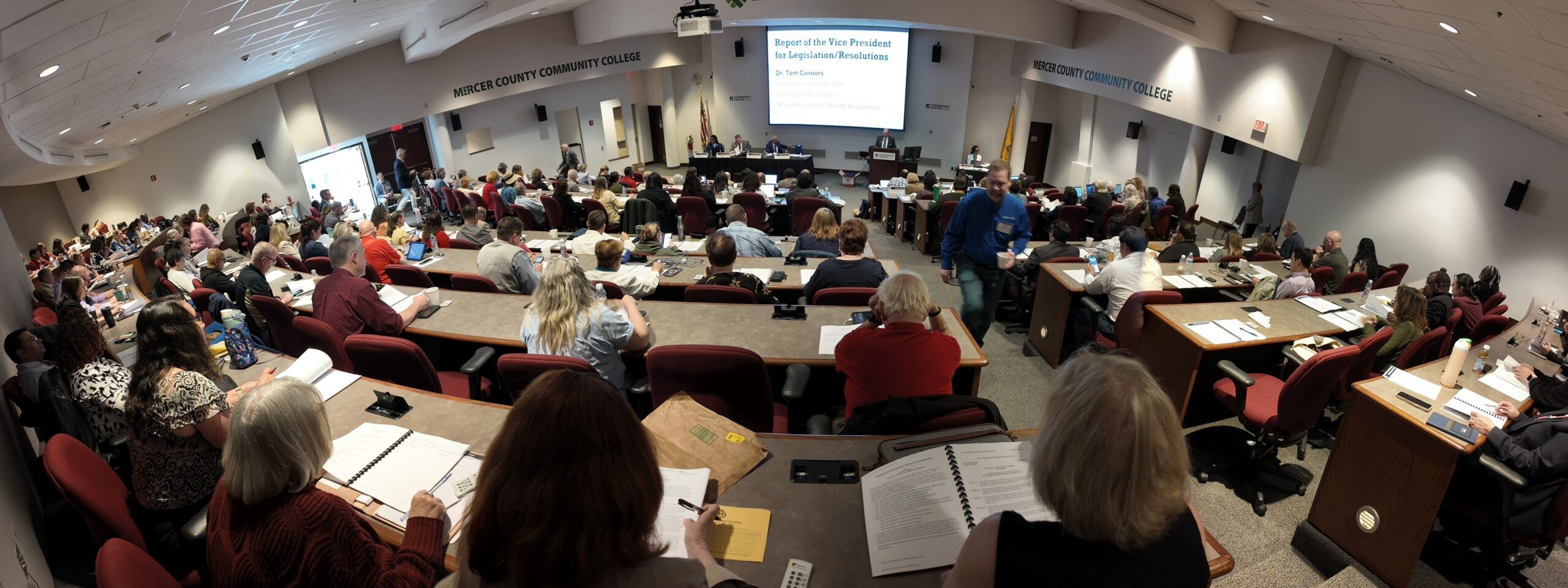
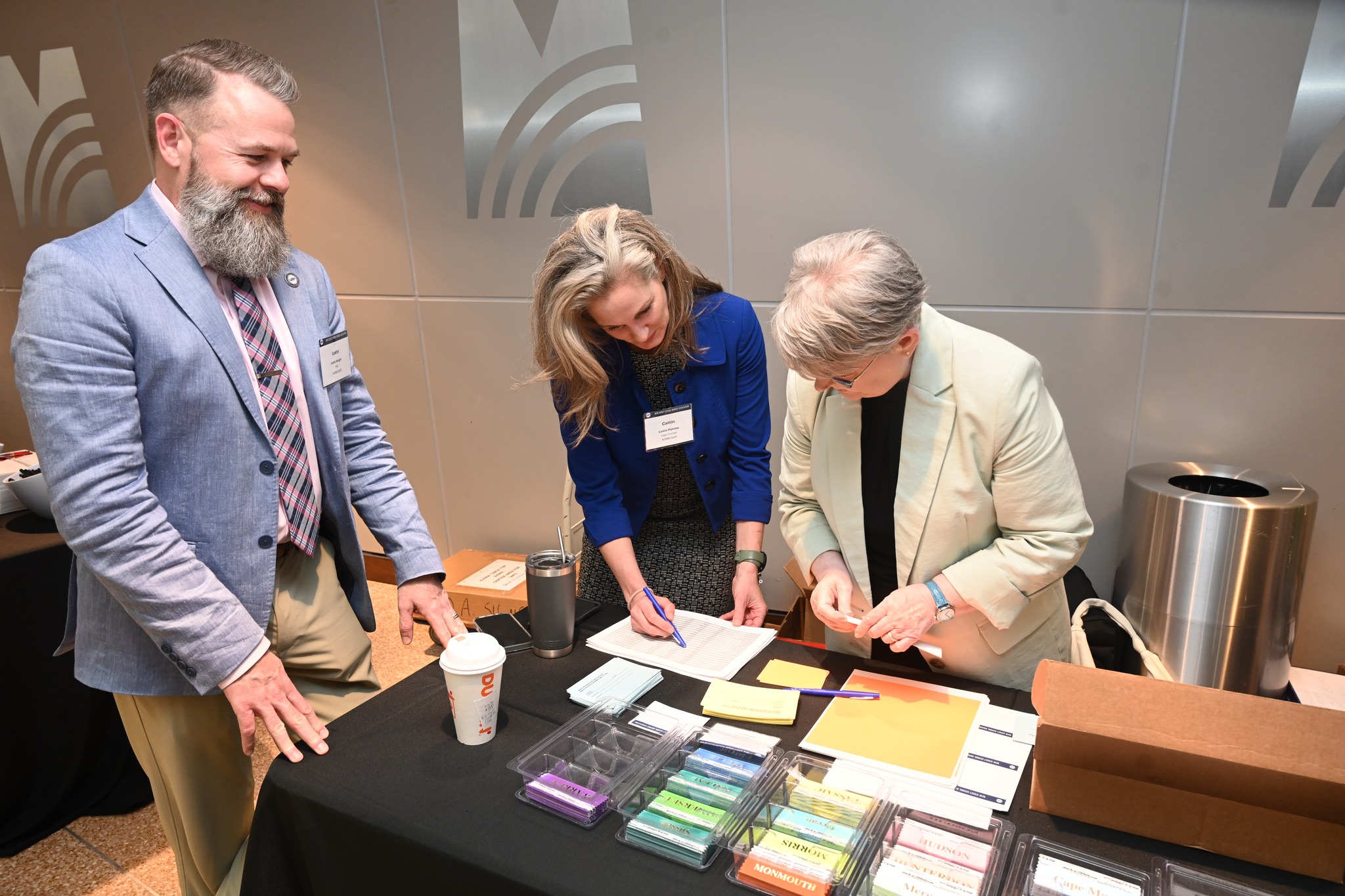
The New Jersey School Boards Association (NJSBA) held its Delegate Assembly on May 16, 2026, at The Conference Center at Mercer County College in West Windsor. Delegates from across the state convened for a morning dedicated to shaping the Association’s future through policy discussions, leadership reports, and the election and installation of a new officer.
The meeting was called to order by President Michael Jacobs.
PRESIDENT’S REPORT
President Jacobs emphasized the Association’s commitment to increasing member engagement through several key initiatives: creating task forces to improve the Delegate Assembly, Resolution, and Nominating Committee processes with greater transparency, confidentiality, and member experience in mind. The Association has also formally trained the Ethics Committee to uphold professionalism, accountability, and high ethical standards.
In partnership with organizations such as NJEA, NJASA, NJASBO, and NJP&S through the Leadership for Educational Excellence (LEE) Group, the Association is advocating for solutions to the rising cost of healthcare in public education.
Additional efforts include appointing new members to standing committees with a focus on geographic, ethnic, and gender diversity to better reflect the communities served. President Jacobs also announced the launch of the “Battle of the Counties” initiative for 2026–2027, aimed at promoting member participation, professional development, county pride, and friendly competition across New Jersey.
Overall, the Association will continue prioritizing transparency, member engagement, professional development, and strong advocacy for public education.
EXECUTIVE DIRECTOR/CEO REPORT
Dr. Timothy Purnell highlighted several recent accomplishments and initiatives undertaken by NJSBA. These included launching a mentoring program for new board members, developing a new request-for-proposals process, implementing ethics training, and expanding services such as crisis communication support and executive coaching.
Dr. Purnell also emphasized the organization’s focus on three core pillars: content, connection, and advocacy. Under these priorities, he noted the addition of several podcasts, including “Monthly Grounds,” the success of the third Women in Leadership event, improvements to mandatory training through Coach Carla, and the redesign of Daily Clips.
He further recognized the governmental relations team in building strong relationships with state legislators and highlighted the well-received Legislative Panel at Workshop 2025. Additionally, NJSBA successfully negotiated a new employee health insurance product that resulted in significant savings for both the Association and its employees.
Dr. Purnell also listed three goals for 2026-2027 which include a labor summit, advocacy best practices for county school boards associations and free resources specifically helpful to districts for re-financing.
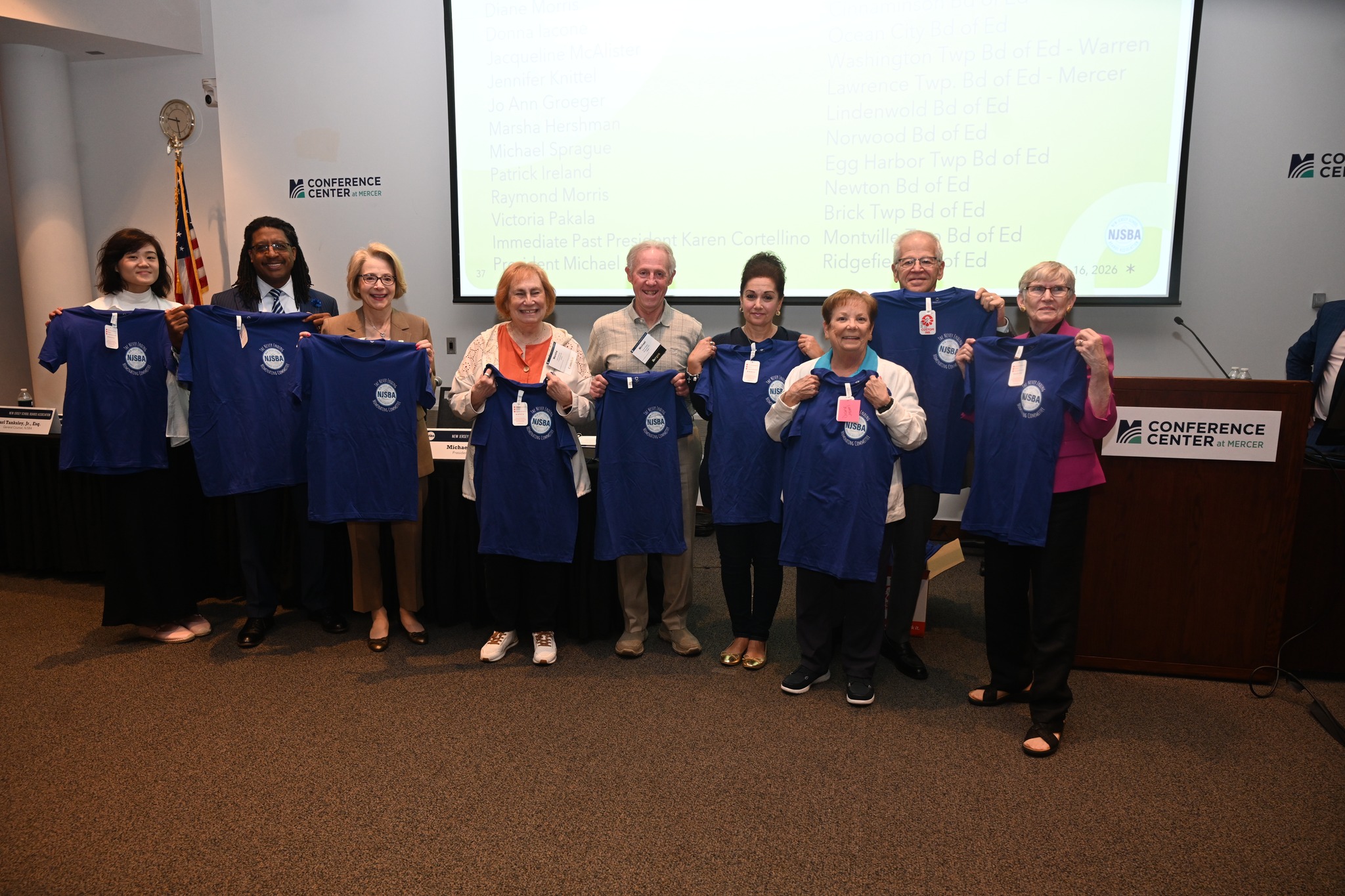
In conclusion, he recognized the extraordinary efforts of the NJSBA Nominating Committee, particularly their work in conducting three special elections over the past year, and honored committee members with commemorative T-shirts.
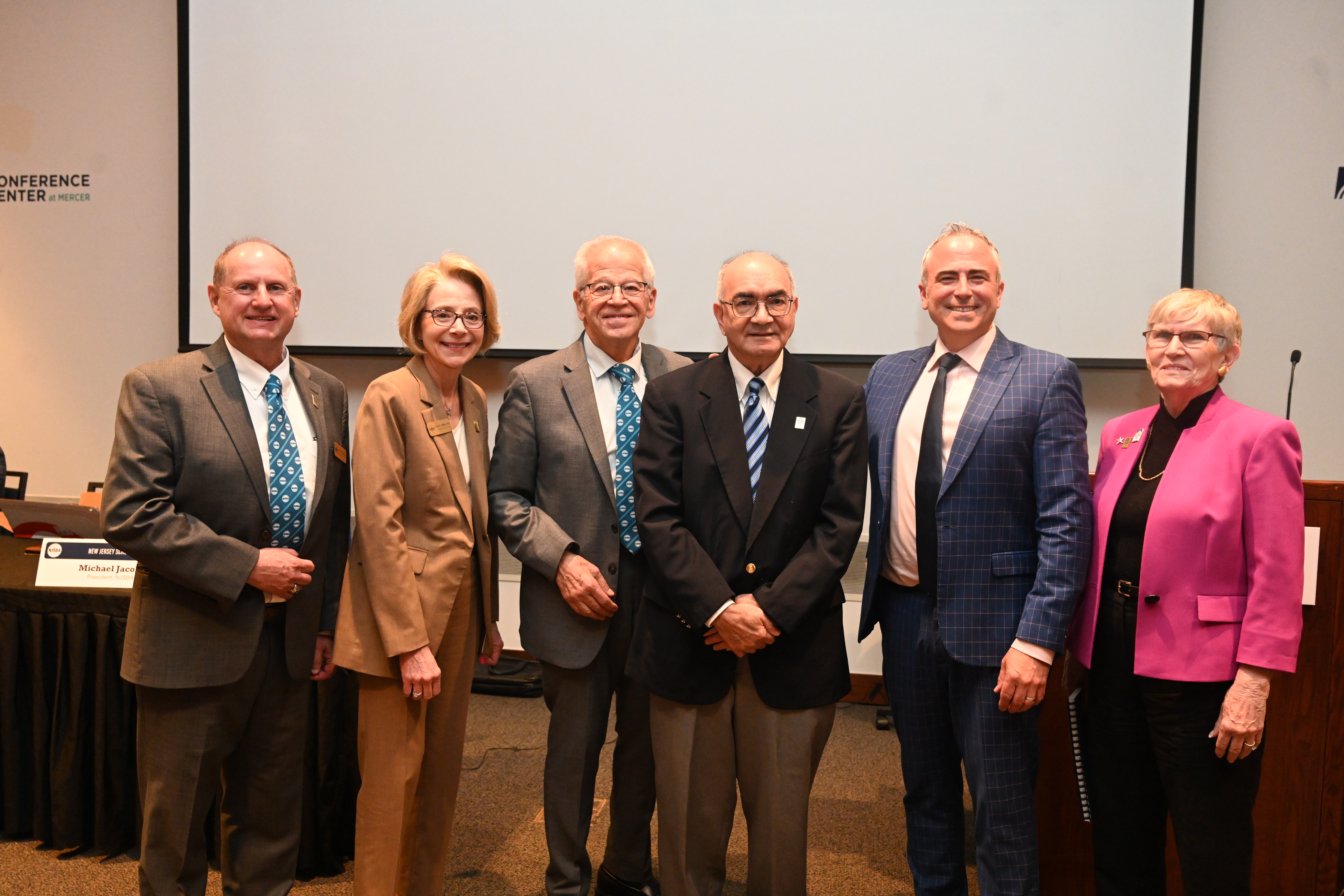 Pictured left to right: Vice President of Finance Dr. Tom Connors, Immediate Past President Dr. Karen Cortellino, President Michael Jacobs, Vice President of Legislation/Resolutions Charles Caraballo, NJSBA Executive Director Dr. Timothy Purnell and Nominating Chair Irene LeFebvre.

RESOLUTIONS
Prior to the review of the resolutions, Dr. Tom Connors, vice-president for finance and interim chair of the Resolutions Subcommittee, presented the committee’s report.
The cutoff for emergency resolutions was May 6, 2026. The Association received one emergency resolution which was denied because it failed to meet the filing requirements.
On April 14, 2026, the resolution subcommittee convened a virtual meeting to review resolutions submitted for consideration. The association received seven resolutions prior to the March 5 deadline. Of the seven resolutions, one was not accepted due to improper formatting and was returned to the sponsor with a detailed explanation of deficiencies. Six resolutions were forwarded to the resolution subcommittee.
RESOLUTION NO. 1
The South Orange and Maplewood Board Of Education (Essex) – proposed that NJSBA adopt a belief that school districts should be allowed, but not required, to use ranked choice voting in school board elections.
RECOMMENDATION: The Resolutions Subcommittee recommended approval of the proposed resolution with the following substitute language that would create additional policy language at File Code No. 9112 – Elections/Appointment:
The NJSBA believes school districts should be permitted to use ranked choice voting in school board elections.
When opened to the floor for discussion, there was spirited debate on the topic, with members presenting arguments both for and against the resolution.
RESULT: The resolution failed
RESOLUTION NO. 2
Essex County School Boards Association (Essex) – The proposed resolution requests that the NJSBA support the inclusion of three separate broad belief statements indicating, in summary, that: public schools must carry out the State’s constitutional obligation to provide all students with a thorough and efficient education; public school buildings must be free from civil immigration enforcement activities; and boards of education should adopt policies and procedures that protect the health and safety of all students, while also honoring valid judicial authority.
RECOMMENDATION: The Resolutions Subcommittee recommended approval of the proposed resolution with the following substitute resolved clause, which would create new policy language to be included in File Code No. 3516 – Safety Issues in Schools: The NJSBA believes that boards of education have a responsibility to ensure that their school buildings and grounds are safe havens for all students regardless of their immigration status and are not to be used as venues for immigration enforcement absent judicial authority.
When opened to the floor for discussion, there was spirited debate on the topic, with members presenting arguments both for and against the resolution.
RESULT: The resolution was approved.
RESOLUTION NO. 3
Egg Harbor Township Board of Education (Atlantic) – The proposed resolution supports the belief that school districts should be involved in discussions pertaining to Payment In Lieu of Taxes (PILOT) agreements; and be able to share the delegated funds in an effort to offset the expenses related to potential increases in student enrollment and/or potential increases in various services required to support additional students.
RECOMMENDATION: The Resolutions Subcommittee recommended approval of the proposed resolution with the following substitute resolved clause, which would create new policy language to be included at File Code No. 3210 – Local Funds: The NJSBA believes that in circumstances where direct allocation of PILOT revenues to
school districts is not provided, municipalities and school districts should consider
negotiated community benefit agreements, or other legally permissible fiscal
arrangements to offset educational costs attributable to development
When opened to the floor for discussion, multiple delegates submitted floor amendments, which amended the resolution’s language to read as follows:
The NJSBA believes that in circumstances where direct allocation of PILOT revenues to school districts above and in addition to the local school tax levy is not provided, municipalities and school districts shall consider negotiated community benefit agreements, or other legally permissible fiscal arrangements whether or not, said development will result in the addition of students in the school district.
RESULT: The amended resolution was approved.
RESOLUTION NO. 4
West Milford Board of Education (Passaic) – The proposed resolution requests that the NJSBA support the belief that New Jersey’s school funding system should recognize structural limitations on local revenue capacity caused by state-imposed land-use and environmental restrictions; and, as a result, should ensure equitable consideration for affected school districts in state aid calculations.
RECOMMENDATION: The Resolutions Subcommittee recommends approval of the proposed resolution with the following substitute resolved clause, which would create new policy language to be included in NJSBA’s Manual of Positions and Policies on Education at File Code No. 3220 – State Funds: The NJSBA believes in an equitable distribution of education aid and related support payments which ensure that all school districts have an opportunity to benefit from government financial assistance, and which considers a school district’s unique circumstances, including, but not limited to, circumstances that impact a school district’s capacity to raise revenue locally.
RESULT: The resolution was approved.
RESOLUTION NO. 5
Glen Rock Board of Education (Bergen) – The proposed resolution supports equitable pricing, transparency, and cooperative purchasing opportunities for instructional materials and digital educational resources, while preserving local board authority over curriculum decisions.
RECOMMENDATION: The Resolutions Subcommittee recommends approval of the proposed resolution with the following substitute resolved clause, which would create
additional policy language to be included at File Code No. 6160 – Instructional Services and resources:
The NJSBA believes that purchasers of textbooks and other curricular materials should be provided with a wide array of consumer information on available programs and products to assist them in making informed selections. When purchasing such materials, districts should employ strategies that promote the efficient use of taxpayer resources, where it is practical to do so.
RESULT: The resolution was approved.
RESOLUTION NO. 6
Secaucus Board of Education (Hudson) – The resolution proposes new language to NJSBA’s Manual of Positions and Policies on Education (P&P) expressing the belief that county vocational school district boards of school estimate “should provide meaningful representation for sending school districts that contribute tuition funding” while preserving appropriate county oversight .It also calls for greater transparency, fiscal accountability, and more predictable tuition-setting practices to improve collaboration and align with regional workforce needs.
RECOMMENDATION: The Resolutions Subcommittee recommended approval of the proposed resolution with the following substitute resolved clause, which would create additional policy language in File Code No. 9300 – Governance: The NJSBA believes that governance and advisory structures for County Vocational Technical School Districts should reflect the shared financial and educational responsibility between counties and local sending school districts. The Association supports statutory and regulatory changes that promote greater transparency, fiscal accountability, and collaboration in decisions related to tuition rates, capital planning, enrollment capacity, and program expansion.
The NJSBA believes that governance models for county vocational-technical schools should encourage the creation of advisory structures that allow local district officials to review tuition methodologies, long-term capital plans, and fiscal impacts prior to adoption.
The NJSBA believes that policies governing tuition increases for county vocational technical schools should include mechanisms that promote fiscal predictability and public transparency consistent with the principles of responsible budgeting applied to other public school districts in New Jersey.
RESULT: The resolution was approved.
INSTALLATION OF OFFICER
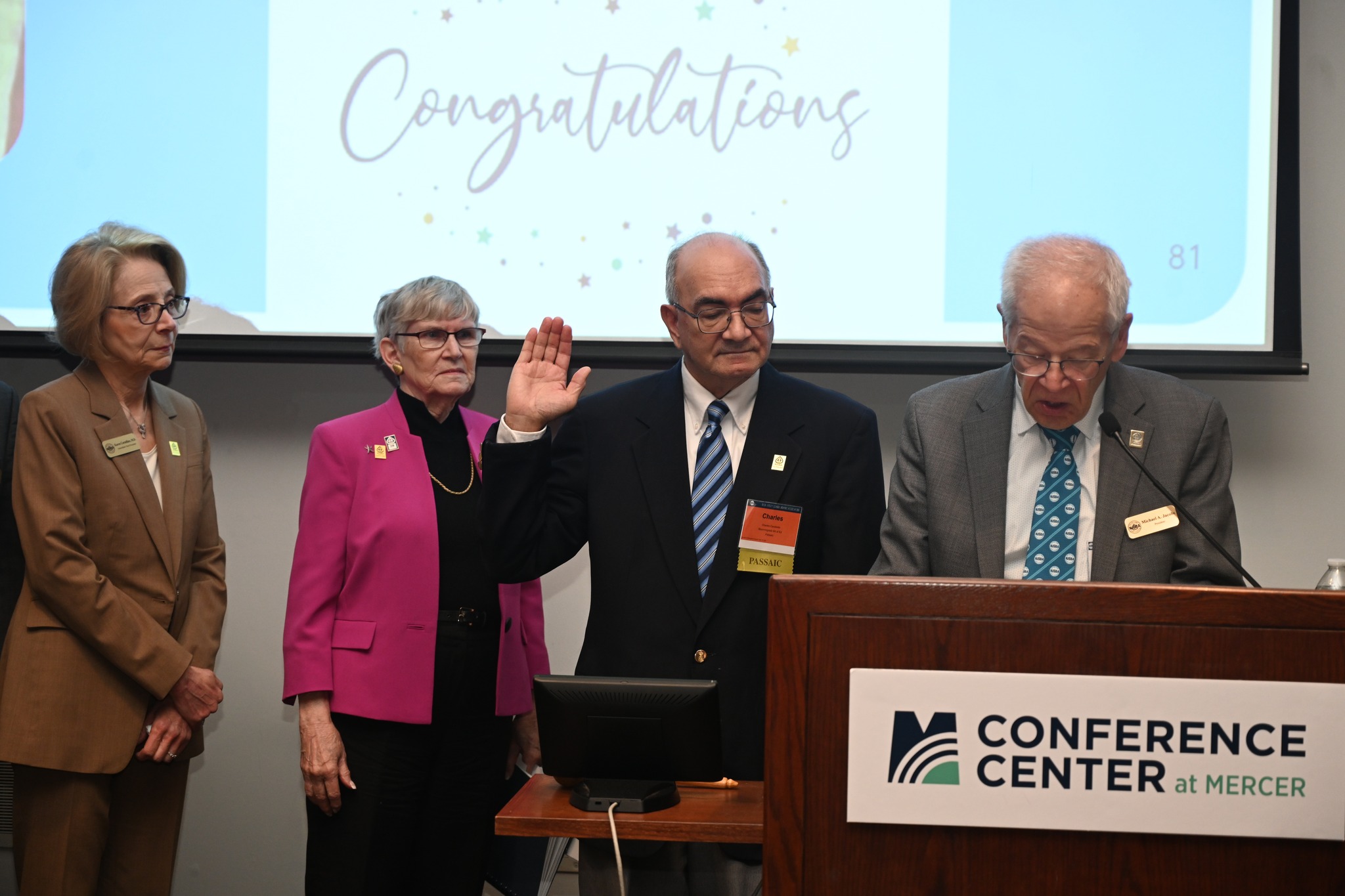
Following the review of the resolutions, President Jacobs conducted the installation of an officer, formally recognizing the new leadership for the 2025-2027 term:
· Vice President for Legislation/Resolutions: Charles Caraballo, Bloomingdale Board of Education (Passaic).
President Michael Jacobs adjourned the Delegate Assembly at 12.35 p.m.